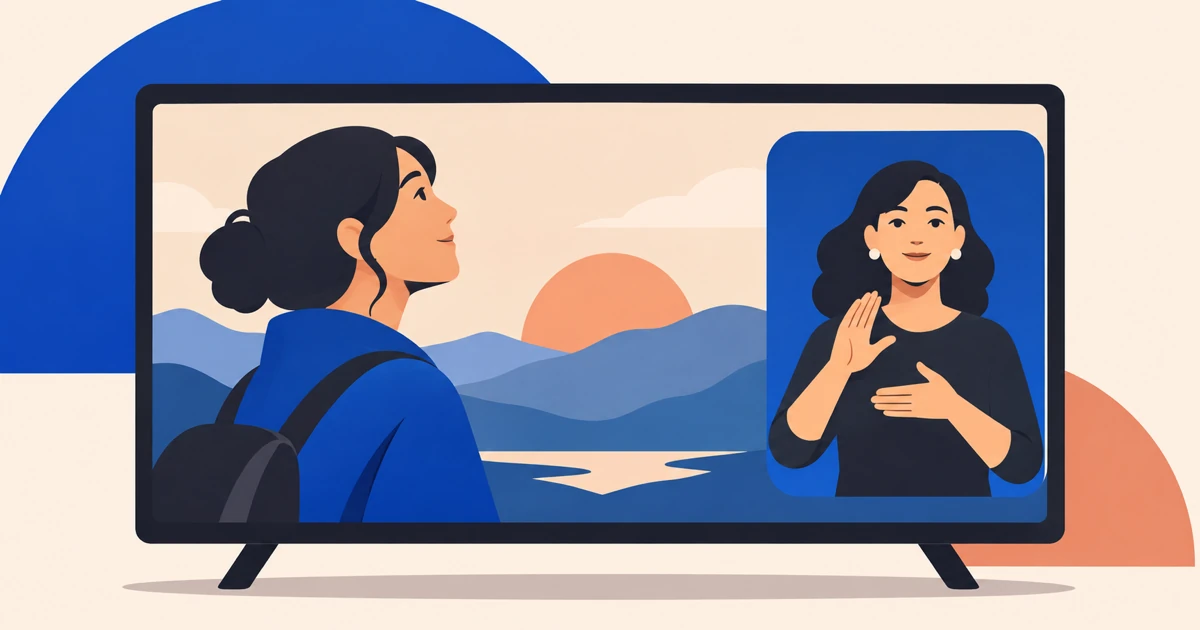
Apple TV now lets viewers switch on sign language interpretation for supported films, without needing a separate version of the movie.
The feature launched on 13 November alongside Being Heumann, a film about disability rights activist Judy Heumann. It's initially available on a small selection of Apple Originals, with American Sign Language (ASL) and British Sign Language (BSL) among the supported options.
It's a relatively small addition to the Apple TV app, but the way it works is interesting.
An interpreter you can switch on
Most streaming services already offer subtitles and audio descriptions for at least some of their content. Sign language interpretation is another way to make a film accessible, particularly for viewers who use a signed language as their primary language.
Apple's new feature places an interpreter within the viewing experience, appearing in a corner of the screen. You can turn it on from the Apple TV app's settings and select the Sign Language button while watching a supported title.
That means you don't have to find a completely separate edition of the film.
Apple also labels supported titles with a Sign Language icon and lets viewers search for content using terms such as “with ASL”. It's a useful detail. An accessibility feature isn't much help if you can't find the films that support it.
Why this is different from subtitles
Sign languages aren't simply spoken languages represented through hand movements. They have their own grammar, structure and ways of expressing meaning.
So adding sign language to a film involves more than translating a script word for word. Timing, facial expression and the emotional tone of a performance all matter.
Apple says the feature was designed and tested by Deaf people and native signers. For Being Heumann, actor Daniel Durant directed the sign language interpretation, with attention to how the performance complements the film itself.
There's another notable choice here. According to TechCrunch's reporting, Apple isn't using AI-generated interpreters. These are human performances created for the content.
That's worth noticing at a time when almost every new software feature seems to involve AI somewhere. Sometimes the better use of technology is to make a carefully produced human performance easier to access.
What can you watch?
The initial selection is limited. Being Heumann and F1 are among the first supported films, with Way of the Warrior Kid and Greyhound expected to follow later in 2026.
On Apple devices, the feature requires iOS 27.2, iPadOS 27.2, macOS 27.2, tvOS 27.2 or visionOS 27.2 or later. Apple also lists support for compatible third-party devices running updated app software.
The limited catalogue is the obvious weakness. An accessibility setting only becomes broadly useful when there's enough content to use it with.
Still, making interpretation a selectable part of the normal playback experience is a promising design choice. It treats accessibility as something built into the product rather than a separate destination.
The next test is whether Apple expands the catalogue, supports more sign languages and makes this an ordinary expectation for streaming rather than a feature available on just a handful of films.
Sources
Every fact in this article comes from one of these.